ARTICLE
WHY CHOOSE US?
1
PUBLIC TENDERS
AND THE CARBON FOOTPRINT
By simplifying access to innovative materials, our module supports innovation and enables each contributor to actively build a greener future.
Integrating the carbon footprint in public tenders is now a major issue in Switzerland. From Geneva to Zurich, public clients demand clear indicators on the carbon footprint from the earliest project sketches, in a context where climate goals aim for carbon neutrality by 2050. For architects, engineers and other building professionals, this requirement means rethinking the entire design process.
From selecting low-carbon materials to optimizing volumes, including energy performance and reversible constructions, every aspect of the project must now be measured according to its environmental impact. This shift represents both a challenge and an opportunity: to design projects that are creative, sustainable and responsible.
With tools adapted such as SwissEcoCarbone, it is now possible to reliably and precisely calculate the carbon footprint of a project from the earliest design stages. This allows project teams to compare variants, make informed choices and meet the expectations of clients.
Public tenders are no longer only about aesthetics or functionality, but a concrete means for construction stakeholders to engage fully in the ecological transition. By integrating the carbon footprint from the very design stage, architects and their partners become key actors of our cities’ sustainable future.
CLEAR OBJECTIVES:
THE SIA 2040 STANDARD AS REFERENCE
In Switzerland, the SIA 2040 standard sets a target value of 6.5 kg CO₂eq/m²/year, i.e. approximately 390 kg CO₂eq/m² over 60 years. This threshold becomes a national reference for both public and private projects. Here are some guidelines to situate environmental performance:
- ● Standard building: 900–1200 kg CO₂ eq / m²
- ● Optimized project: 400–600 kg CO₂ eq / m²
- ● Exemplary project: less than 400 kg CO₂ eq / m²
2
CIRCULAR ECONOMY AND PRACTICAL SOLUTIONS
AT THE HEART OF PROJECTS
How to prioritise the circular economy in construction and renovation.
2.1 Integrate circular economy principles from the design phase
It is during the design phase that everything is decided. The idea is to think reversibility, modularity, disassembly.
To do:
- Choose dismantlable and reusable materials
- Plan buildings that are easily adaptable
- Opt for minimally processed solutions (raw wood, natural stone, raw earth, etc.)
2.2 Use reclaimed or recycled materials
Bio-based materials, recycled products or reused materials are increasingly accessible.
Concrete examples:
- Recycled concrete
- Windows, doors or partitions recovered
(via the recycling & reuse module of SwissEcoCarbone) - Reclaimed wood for flooring or fittings
2.3 Promote short supply chains
Local sourcing reduces the carbon footprint linked to transport and supports the regional economy.
How to find the right partners: SwissEcoCarbone.ch
2.4 Collaborate with architects and consulting firms specialised in circular construction
Some architects or engineering offices are already trained in circular construction.
Look for:
- SIA Circular Construction certification
- Experience in reuse or bio-based material projects
- Commitment in tenders or pilot projects
2.5 Renovate rather than demolish
Before constructing a new building, consider:
- Rehabilitate an existing building
- Add a story instead of building from scratch
- Convert offices into housing
3
HOW AI CAN HELP US
ACHIEVE OUR GOALS
Artificial intelligence: a key lever for achieving carbon transition by 2050.
Carbon neutrality by 2050 is an ambitious goal…

1. Predictive analysis and optimization
2. Improving energy efficiency
3. Optimizing the lifecycle
Towards augmented and responsible construction. AI brings agility and precision: it is the key to a sustainable future.
4 WHO ARE WE?
SwissEcoCarbone
is a Swiss innovative startup, born from the desire to sustainably transform the construction industry.
Our mission: accompany professionals towards greener, more efficient and forward-looking practices.
Founded by a team of passionate experts, SEC develops smart tools to simplify carbon analysis, optimize costs, and fully integrate circular economy principles from design onward.
Our means to act
A comprehensive platform integrating 3D modelling, carbon footprint, financial estimation, quantities, and more. Advanced modules based on artificial intelligence to anticipate, optimise and automate decisions.
Our commitment & ambitions
SEC is more than a tool: it is a partner to build the future. Together, let’s create responsible, innovative projects aligned with today’s climate challenges.
By 2035, we aim to support several partners in significantly reducing their carbon footprint.
5
OUR PERSPECTIVES
FOR THE FUTURE
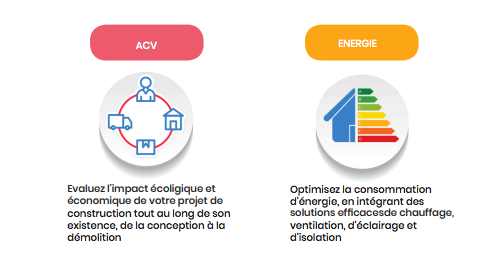
Upcoming modules and features
NETWORKS & PARTNERSHIPS
Together towards a sustainable future: At SEC, we develop strategic partnerships with construction companies,
sustainable material suppliers and local authorities.

Leave a comment